

This essay first appeared in The Bell Ringer.
We were mid-exam when the knock came at the door.
Before I could protest—we need quiet right now!—my principal’s face poked through the door, a conspiratorial grin on her face. Behind her stood the superintendent of my small district on the outskirts of New Orleans, a mythical figure I had only ever seen from the back of a crowded hall. She was clutching a large bouquet of flowers with both arms.
The principal entered and cleared her throat. My sixth grade students began to abandon their papers, turning to face her with wide eyes. Her mouth began to move, but the words didn’t immediately register in my brain.
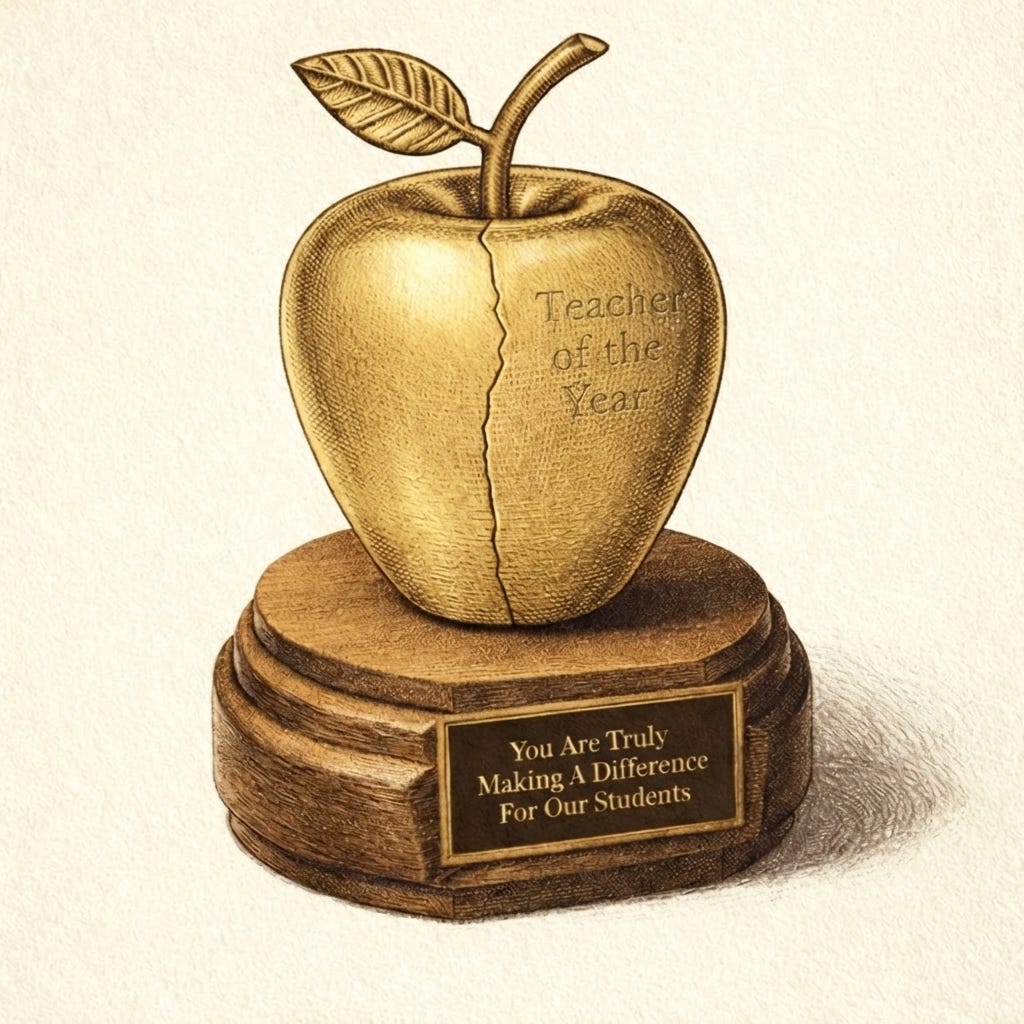
“Let’s see a smile on that face, Mr. Morin,” she said, noticing my dumbstruck expression. “You’re the Teacher of the Year.”
I snapped back to reality with the raucous applause of my students, who were partly proud of me but mostly thrilled by the interruption. It was clear they would be demonstrating their knowledge of the unit vocabulary another day.
While the honor was real, the smile that formed was forced. As I posed for a picture that would appear in the paper, (grimacing slightly at the exam copies that were now beginning to scatter the floor), I couldn’t help but wonder what exactly made me deserving of such pomp.
At just twenty-four years old, I was more than a little wet behind the ears. Classroom management was still a daily battle. My curriculum, however earnest, was largely incoherent, and I was lucky to ever have a majority of the room truly on task during work time.
I was still a developing teacher, and I knew it. I knew my principal knew it. So why me?
What I would come to learn over time is that the qualities schools are quickest to reward aren’t always the ones most closely tied to student learning.
And years later, after becoming a far more effective teacher by the system’s own measures, that early recognition all but disappeared.

Recognition Without Results
Up to that point in my teaching career, I had put in my share of late nights and early mornings. I battled the copier, authored hundreds of worksheets, endured unpleasant parent phone calls. If exhaustion was any measure of effectiveness, I was hitting the ball out of the park.
My school was enduring a difficult stretch—high teacher turnover, rapid enrollment growth, and a new administration trying to find its footing. In that context I could almost see how I became a Teacher of the Year candidate—I was a happy warrior: eager, visible, and genuinely committed.
But none of that inherently made me an effective teacher. The truth of that hit with full force the following August, when my principal called me into her office to review my student data. Not only had my students significantly underperformed their sixth-grade peers at the school, but some important subgroups, including language learners, students with IEPs and Black boys had fallen the furthest behind.
Suddenly the college visits I had organized, the flashy bulletin boards I had assembled, and the “big goals” I’d called every family about didn’t seem to matter much.
“These are the kids you said you’re here to help, Mr. Morin,” she said bluntly. “So I suggest you begin to figure it out.”

Studying Excellence
At the time, New Orleans was in the midst of one of the most sweeping urban education reform experiments in U.S. history. In the wake of Hurricane Katrina, the state took over the city’s schools, laid off nearly every teacher, and reopened buildings to a new generation of educators with ambitious, and often controversial, ideas about what schooling could look like.
I didn’t fully understand the politics of it then1, but what I did understand was this: some of these new schools seemed to be working. Really working.
While I was still struggling with the basics of management, peers working inside those buildings talked casually about systems and routines so tight they barely needed enforcement.
When I considered abandoning my homework policies due to low completion, those teachers were answering student text messages, coaching them through math problems in real time.
And when I felt tempted to explain away a student challenge with demographics or circumstance, those teachers were mapping out how a particular student might defy the odds to earn a scholarship to one of the city’s most competitive high schools.
My award elevated my standing among this peer group, but the distinction was thin. When one of them asked about my classroom or pressed me for feedback, I found myself realizing, uncomfortably, that I had little of substance to offer. They were developing their craft more quickly than I was, and I didn’t yet know how to close the gap.
Eventually, curiosity overcame insecurity. I took a day off and paid one of those schools a visit.
Their abstract anecdotes felt almost magical when I saw them brought to life. Students gathered for vibrant morning meetings. Meticulous, chalk-smeared boards tracked progress toward school wide goals in the halls. Hand-painted quotes and value statements filled the stairwells. Attention was visible everywhere—snaps, nodding heads, steady eye contact. Robust student work proudly covered classrooms and hallways.
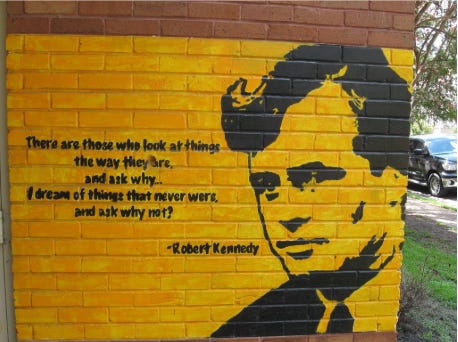
Nothing here felt accidental, and it was easy to see that the adults were all-in. So were the kids. Watching things work, my eyes welled up with tears. It may sound ridiculous, but to believe deeply in a mission like educational equity while remaining ineffective at realizing it is a slow grind on the soul. To witness excellence—just as doubts about what was possible in my own classroom had begun creeping in—was a powerful release.
Much of the mechanics behind the school’s success remained invisible to me that day. But once I had seen what was possible, I knew I wouldn’t be able to return to my own classroom without trying to close the gap, even if I didn’t yet understand how much of what I had seen extended far beyond any single teacher.
My first attempts to replicate what I had seen led to frustration. Asking thirty students to enter a room calmly, gather their materials and begin work is a fool’s errand when they’ve grown accustomed to chaos and flexible seating in the classroom across the hall. Safe hallways are hard to build when most teachers are checking email during passing periods.
So I returned to classrooms like this again and again. Over time, the focus of my visits shifted from inspiration to study. That discipline reshaped my practice, then my identity as a teacher and eventually my understanding of what kind of work schools are actually capable of doing together.
I began talking with my grade-level teammates about what I was seeing in these other schools: hallways, transitions, shared expectations and the power of coherence. Slowly, we started trying things together. We aligned routines, tightened norms, and began treating culture like a collective practice we could learn.
For the first time, improvement no longer felt mysterious. With a full team rowing in the same direction, we weren’t just seeing better results, we could name why they were happening, and how to sustain them.
Waiting for the Parade
Five years after I began spending my days off studying great classrooms, the classroom I’d imagined and worked toward had finally taken shape.
I had returned home to Denver in 2013 and joined a founding team opening a new school. We had a newly renovated building in a desirable neighborhood, open enrollment that attracted a diverse group of families from across the metro area, and a committed, coherent grade-level team.
Strong cultural alignment translated into safe hallways, bought-in students and classrooms where time was treated as precious. With excellent instructional support and a robust curriculum, my students spent their days immersed in rich, complex texts and wrestling with whole novels rather than fragments. An ambitious teaching partner pushed me constantly to read more, refine faster and take risks I might not have taken alone.
By 2017, things had progressed. Over the last few years, my culture, curriculum and instruction had improved dramatically. Class felt alive. My advisory group was inseparable. Students were producing writing and analysis that genuinely astonished me.
That year my sixth graders posted a median growth percentile of 90 on the state exam—well above the state’s threshold for “high growth,” and higher than any other middle school ELA teacher in Colorado2.
When the data arrived, I waited, somewhat naïvely, for the parade to begin. The gains in my practice had been hard-earned, and I was surrounded by colleagues doing exceptional work.
But the state didn’t notice. The superintendent sent no note. Even my own instructional coach didn’t observe my classroom for months. Aside from my teaching partner, no teachers came to see what was happening. No advice was sought. No blueprint requested.
My mind wandered back to the enthusiastic young teacher in New Orleans who had once gotten his picture in the paper despite losing ground with his students. The contrast was difficult to ignore.
If this is how the system responds to clear evidence of instructional impact, it seems worth asking: what, exactly, are our systems designed to notice?
Getting Past Good Intentions
Ask a principal to name the great teachers in a building and to explain why and you’re likely to hear a wide range of answers.
Teachers are admired for many reasons. Some radiate warmth and joy. Others anchor their communities through coaching, rallies or clubs. Veterans carry institutional memory, mentor new teachers and help schools feel coherent over time.
All of that matters. But it also raises a harder question: what is the most important function of a school?
Community, safety, and belonging are necessary precursors to learning. At the same time, it’s possible, even common, for a school to enjoy a strong reputation and graduate nearly all of its students without consistently producing strong academic outcomes.
Since 2001, we’ve had access to unusually robust data on student learning at the district, school and classroom level in tested subjects. Assessments are expensive and sometimes unpopular, but in a country where academic opportunity is unequal along lines of race and class, tests offer something rare: a clear view into which schools and teachers are helping students learn the most, often in classrooms serving students with the greatest needs.
By any reasonable logic, those should be the places most deserving of recognition, or at least curiosity. Instead, in a data-rich profession, we often treat the most important data as impolite.
This reluctance isn’t hard to understand. Teaching is a profoundly human enterprise, and the coherence of teams, the legitimacy of leaders and the trust of families are often more fragile than we care to admit. Evidence of instructional impact can destabilize those relationships. It raises uncomfortable questions: why a novice teacher might outperform a respected veteran; why students with exceptionalities are falling further behind; why schools with every visible advantage still struggle to produce strong academic growth.
Studying excellence also has a destabilizing effect: once positive outliers are visible, it becomes harder to explain away persistent underperformance elsewhere.
In a profession shaped by inequality, those questions can feel less like invitations to learn than moral indictments on the practitioners. Add overextended leaders, litigious parents and a workforce already stretched thin, and it’s easy to see why achievement data is often avoided rather than examined.
When that happens, excellence doesn’t disappear, it simply hides in plain sight.

An Open Door
As a struggling young teacher, my days spent observing other educators in the city’s best schools didn’t give me a script but instead set a standard, and gave me the hunger to find my own way toward it.
Again and again, expert teachers opened their classrooms to me, and each visit left me changed.
Teaching now faces a crisis of retention. But beneath the policy debates and technology promises is a simpler problem: too few teachers ever get to see what excellence looks like up close—or to know that, when they achieve it, it will be noticed.
Back in New Orleans, it’s easy to see that the flowers and applause marked my effort and presence, not the learning in my classroom.
Years later, when the learning was unmistakable, the silence that followed made the lesson clear: our systems are far better at celebrating intention than at recognizing excellence.
If we want to keep our best people, and become a profession where mastery is cultivated rather than hidden or designed away, we might start by making excellence in our schools impossible to ignore.

Among teachers serving 50 or more students.
I can definitely feel it in my bones because I seem to be going through the same cycle myself. I hope that one day I can achieve instructional excellence in my classroom.