

The invitation caught me a little off guard.
“You’ve got to get in to see what they’re learning. They LOVE it,” he said with an inspired glint in his eye.
The next morning I made a point of slipping into a desk in the back of his room to see what all of the fuss was about. “This book is awesome,” one of the sophomores whispered at me, thumbing through his tattered copy of Born a Crime.
The bell rang and the teacher tapped play on his laptop. Trevor Noah’s voice filled the room—bright, effortless—as students bowed over their books.

Soon, Noah relayed a childhood incident in which he relieved himself on a newspaper in the kitchen rather than brave his family’s vermin-infested outhouse.
“You are never more yourself than when you’re taking a sh*t,” Noah boomed, sending the boys into roaring fits of laughter.
The teacher shot me a nervous look, worried I wouldn’t like what I was seeing. And in a sense he was right. But the opportunity I sensed that day wasn’t what he imagined.
Apartheid is obviously worthy of study. And the bathroom humor? Crude, yes, but funny and illustrative of the living conditions Noah’s family endured.
The problem wasn’t the topic or the poop jokes. Born a Crime, which the publisher recommends for grades 11–12, carries a Lexile of 770—firmly in the elementary band.
The kids were having fun, but they were capable of so much more.

Why Students Still Need the Classics
“The problem isn’t that students struggle with complex text. The problem is that we’ve stopped asking them to read it.”
- Timothy Shanahan
In today’s equity-saturated discourse, “old, dead, white guys” has become shorthand for texts assumed to be irrelevant to a diverse student body—or worse, ideologically dangerous. And while the impulse behind this skepticism is understandable, it often collapses into a false conclusion: that students can’t handle complex literature and therefore must be protected from it.
To understand the importance of the canon, you needn’t accept that its core virtues are derived from some fixed idea of a “cultural inheritance.”
Instead, it’s important to recognize that the texts within it embody a level of linguistic, structural, and conceptual complexity that modern texts—especially modern YA—rarely even attempt.

And while the layered density of canonical prose can feel daunting, Reading Reconsidered reminds us:
“(Difficulty) becomes a hurdle to be overcome by good teaching, not an argument against reading it… when the criterion is solely accessibility and not greatness, the result is that students who start out as weak readers almost never study the same rigorous texts that imply our highest expectations.”
Sidelining classic literature in the name of accessibility has the side effect of depriving students of the very struggles that build strong readers.
Put simply, complexity isn’t a barrier to equity; in many ways, it’s the surest path toward it.

Modern Texts Are Easier — And That’s a Problem
The research is unequivocal: modern prose is shorter, flatter, and less syntactically demanding than the prose students routinely encountered in previous generations—often sharply so.
The consequences of this shift show up clearly in performance data. ACT’s landmark 2006 study found that students across nearly all score bands struggled profoundly with complex texts. Performance rose predictably on “uncomplicated” and “more challenging” passages—but on complex passages, all but the highest performers hovered only “slightly above the level suggested by chance.”
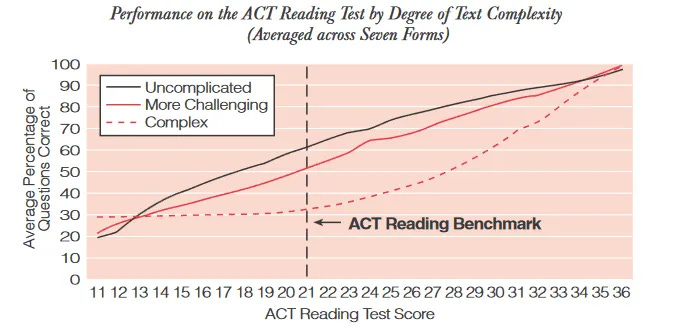
Its conclusion is blunt:
“The clearest differentiator in reading between students who are college ready and students who are not is the ability to comprehend complex texts.”
And students cannot develop that ability without sustained exposure to demanding prose.
Attempts to formalize expectations around complexity—like the Common Core’s introduction of text complexity bands—have done little to shift classroom realities.
Publishers still push below-band materials, districts still adopt excerpt-driven curricula, and many teachers have never encountered the complexity guidance at all.
As a result, the pattern persists: a student interested in mythology is still more likely to be handed The Lightning Thief than The Once and Future King
Interrupting that pattern requires a nuanced understanding of how complexity is measured in the first place.
What Lexile Misses About Complexity
No measure of text complexity is more widely recognized than Lexile.
Its appeal is obvious: almost every book a student could encounter has already been scored, and any passage can be run through the algorithm to generate a quick, concrete number. In a field where quantification is rare, Lexile provides a metric that feels objective—and often useful.
But Lexile measures only two things:
sentence length
word frequency / rarity
…and that’s it.
This narrow focus produces predictable anomalies: Charlotte’s Web “outscores” Of Mice and Men, for example, and invented terms in YA fantasy novels (“muttations,” “muggles”) inflate scores despite adding no real linguistic challenge.
None of this captures the structural intricacy, abstraction, narrative techniques, or knowledge demands that make literature resistant to easy meaning-making.
So while Lexile can signal surface difficulty, it rarely captures the full picture of why a text is complex.
For that, we need a qualitative lens.
Luckily, a simple but powerful framework exists.
The Four Dimensions of Text Complexity
Student Achievement Partners (SAP)—co-founded by three lead writers of the Common Core—has produced some of the most genuinely useful resources available for understanding the standards.
In my view, the crown jewel is their set of text complexity rubrics, freely available from Achieve the Core.
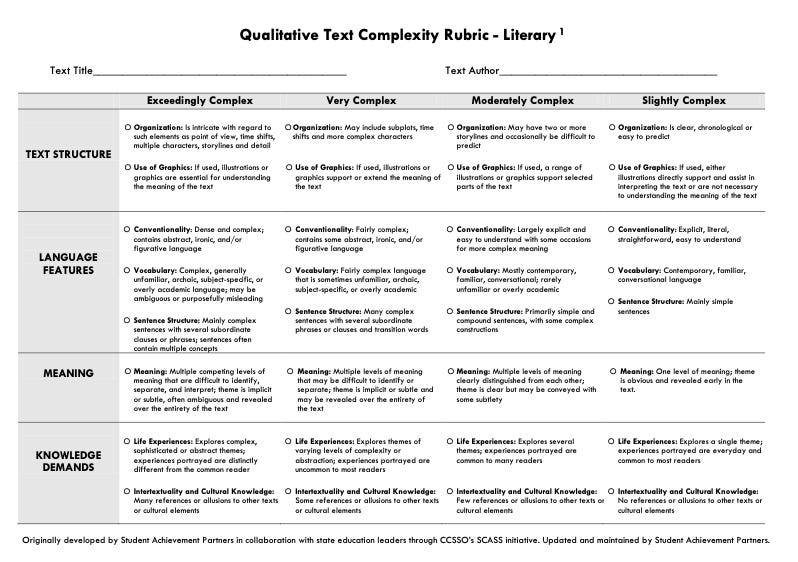
Across both the literary and informational rubrics, complexity is assessed in four dimensions—text structure, language features, meaning, and knowledge demands—rated along a continuum from “slightly complex” to “exceedingly complex.”
What makes the rubrics invaluable is that they take the concept of “complex text” out of abstraction and ground it in something teachers can actually analyze.
Used well, they help illuminate which texts merit whole-class study and how to approach them instructionally.

A Tale of Two Texts
To prepare students for the literature they’ll face in the upper grades and beyond, we have to begin with the end in mind. Dickens is a useful benchmark—not simply because he consistently shows up on the AP exam, but because his work engages every strand of the complexity framework.
Consider the iconic opening of A Tale of Two Cities:
“It was the best of times, it was the worst of times, it was the age of wisdom, it was the age of foolishness, … we were all going direct to Heaven, we were all going direct the other way…”
It’s a 94-word sentence, built through parallel antitheses (“best of times / worst of times,” “wisdom / foolishness,” “direct to Heaven / direct the other way”). To follow this, a reader must navigate:
Complex text structure, via long, patterned sentences
Demanding language features, via irony, abstraction, formal diction
Layered meaning, via contradictory clauses that generate thematic tension
High knowledge demands, via historical context about revolution and moral upheaval
None of this is explained. The sentence assumes stamina, inferential ability, and background knowledge on the part of its reader.
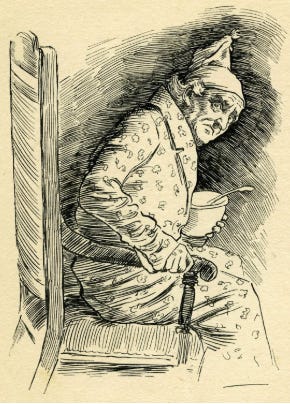
Now read the opening of The Lightning Thief, a novel widely adopted across middle-grade curricula and routinely treated as a 6th grade anchor text:
“Look, I didn’t want to be a half-blood.
Being a half-blood is dangerous. It’s scary. Most of the time, it gets you killed in painful, nasty ways.”
Later chapters keep the same simplified register:
“Most kids would freak out if they saw a teacher turn into a monster. But me? I was already thinking about how I was going to get blamed for it.”
Brief declarative sentences, conversational diction, fully explicit meaning, and no demands on a reader’s historical or conceptual background. A reader simply follows the narrator’s literal statements in chronological order.
The cognitive load is virtually nonexistent.
A curriculum built on novels like The Lightning Thief—however enjoyable—cannot prepare students for Dickens, Hurston, Ellison, Brontë, or any writer operating in a more demanding register.
In the end, choosing texts is less a question of taste than of preparation — and the stakes for students could not be higher.
Building a Runway
If Dickens represents the deep end of textual complexity, middle-grade students need a runway—texts that stretch them in the right ways without overwhelming them.
Reading Reconsidered offers one:
“(A book like C.S. Lewis’) The Magician’s Nephew is, in short, a starter kit for students who aspire to one day read Dickens.”
And it’s true. Lewis’s writing in The Chronicles of Narnia introduces the very features students will face later: antiquated syntax, formal diction, narrative intrusions, and a tone that assumes the reader can infer, reflect and keep up.
Take this line:
“Now the trouble about trying to make yourself stupider than you really are is that you very often succeed. And this was the case with Uncle Andrew; for he began to believe in his own magic, and the more he believed in it, the more he invented.”
It’s funny and wise, but it also asks something of the reader. The sentence coils back on itself, folds in nested clauses, and lets the narrator poke his head out to address you directly.
Or consider the White Witch Jadis, whose language mirrors the grand register of Victorian prose:
“I had forgotten that you are only a common boy. How should you understand reasons of State? You must learn, child, that what would be wrong for you or for any of the common people is not wrong in a great Queen such as I. The weight of the world is on our shoulders. We must be freed from all rules. Ours is a high and lonely destiny.”
Students have to track abstract political vocabulary, follow Jadis as she slips between four different pronouns, and discern the formal, imperious tone that constructs an insidious moral hierarchy.
Importantly, that’s the same kind of linguistic and conceptual work they’ll later face in Dickensian figures like Scrooge or Madame Defarge.
Lewis challenges developing readers without overwhelming them, offering early practice with antiquated prose in a manageable context.
Now contrast that with Riordan’s universe—prose built from short declarative sentences and direct emotional cues:
“Being a half-blood is dangerous. It’s scary.”
There is simply no comparison in the cognitive work these texts demand. And a school year is far too precious to spend on books that are merely designed to amuse.
Raising the Horizon
“The surest way to hold students back is to keep them in books they can already read.”
— Timothy Shanahan
Back in that sophomore classroom, the familiar pattern was playing out.
In our debrief, we set Born a Crime beside a brief passage from Mark Mathabane’s classic memoir of life under apartheid, Kaffir Boy, and the difference in cognitive demand was impossible to miss.
“There is a death far worse than physical death, and that is the death of the mind and soul… when you cannot clothe, shelter and feed your loved ones, suffering miles away, forcibly separated from you.”
My colleague saw it immediately, reflecting that he had chosen the book out of a desire to engage his kids—not giving heavy consideration to the extent to which it was developing them as readers.
Every curriculum choice either raises or lowers the horizon students can reach, and building serious thinkers requires serious texts.
If we want students to inhabit a bigger world, we have to give them the books that will expand it.

Luke, I love your nuanced analysis of text complexity! I often would note when telling parents not to overly rely on Lexile, how A Wrinkle in Time is rated at 740, but has really complex themes and characterization, suitable for older kids. Your Mice and Men example does the same thing!
I’m interested in your take— if some kids are coming into the high school classroom having been taught using only short passages from textbooks, might the teacher be justified in choosing a high interest text like Trevor Noah’s to get kids past the “reading real books is boring” hurdle that’s been placed before they arrive, and then ease them into more rigorous texts? Might there be interesting complexity in concepts about how to structure a memoir? It’s also very topically interesting to read now that white men who grew up in South Africa during apartheid (Musk, Thiel) have such power shaping the US today. Those discussions could be rich and rigorous, right?
All those wonderings aside, I’m all for your main point, which is to build students’ capacity to read rigorous, complex texts.