

“He took the DINOSAUR SUBTRACTION!” the teacher yells in mock horror as his class erupts in cheers. The camera lingers on a triumphant young boy, radiant as he claims his prize—a math worksheet.
So ends an iconic video—a staple of teacher training in the late aughts, and one of my earliest introductions to teaching. In it, a young teacher works the room, letting students in on a “secret”: they just might get away with trying advanced math—if he can manage to sneak it into the building late at night.
The third-graders eat it up. Leaning over their desks, they beg for more math. The teacher raffles off extra practice to “lucky winners,” and the class erupts into a spontaneous chant about their own abilities: yes we can!
Even now, I’m impressed by his charisma, his preparation, and his ability to so thoroughly enmesh students in the culture of his room by the fourth day of school. It’s a masterpiece.
As a young teacher, I was no less inspired—and plenty confident. I believed my students would lean in, attentive and hungry for everything I had prepared. Class would be raucous, joyful, and productive, so long as I brought the right material and the right attitude.
But once in the classroom, I learned that good intentions don’t organize a room. What filled my days instead was endless chatter, heads on desks, and constant bargaining to keep students on task. Class was chaotic, unproductive, and largely indifferent to my ambitions.
“You need to engage them more,” a mentor advised, doing her best to help. “Get them up and moving!”
Without any real management muscle, that advice backfired. When activities entered my lessons, things got worse—not better. A five-minute gallery walk might stretch to fifteen, with more property damage than text analysis completed by the time we returned to our seats.
Over time, those activities began to exist only on paper. In practice, they were replaced by my exhortations for students to sit silently in their seats, an attempt to survive the day.
Despite my intentions, I had adopted stillness as the default for my class—driven by a fear of losing control. And it was a decision that would strip the room of the very energy it needed to thrive.

Why Stillness Fails the Adolescent Brain
Prolonged stillness carries real cognitive costs for adolescent learners. A large review by Donnelly et al.1, synthesizing decades of research on physical activity and cognition, writes:
“There is strong evidence that physical activity has a positive effect on cognitive functioning, particularly on attention and executive function.”
When movement disappears, attention erodes. Sustained passive listening is associated with gradual attentional decline—especially for adolescents.
The classroom I had created was developmentally misaligned with the students in front of me. Low productivity, frayed relationships, dragging bodies, and a brittle classroom culture shouldn’t have been surprising—they were built into the design.
The answer, of course, isn’t chaos. Swinging too far in the opposite direction—toward high-energy, low-accountability activity—creates its own problems.
Students still need substantial amounts of explicit instruction and carefully structured discussion, much of which happens from their seats and demands sustained cognitive effort.
The challenge, then, is not choosing between stillness and rigor. It’s designing classrooms that privilege attention to make rigor possible.
My breakthrough came when I stopped asking students to fight their bodies and started designing class with them in mind.

Listening is a Physical Act
Teachers are typically great at defining what students should do during work time: how much to write, who they may talk to, how to ask a question, and how much they’re expected to complete.
Listening, however—the part of class that occupies the most time—is often treated as if it needs no instruction at all.
When someone is speaking, teachers may say “listen carefully” or “pay attention,” but more often they say nothing at all, implicitly treating silence as a sufficient condition for classroom talk to proceed. Students respond accordingly: some listen, some doodle, some drift. From the outside, it’s difficult to tell the difference.
The solution is surprisingly simple: make listening a visible, physical act.
In practice, that means asking students to square up and look at whomever is speaking in the room.
In my classroom, if I’m speaking, I wait until students are looking at me.
If a classmate is speaking, I direct students to orient toward them—and we don’t continue until everyone is ready.
And if I catch myself distracted while a kid is speaking, I stop, apologize, and ask them to repeat their point, modeling the kind of attention and respect that I expect from everyone else.
So why insist on something this small?
Looking while listening works because attention is both physical and contagious.
Orienting your body toward a speaker quite literally spatializes your attention, anchoring it to whatever you’re facing. When a group does this together, others are naturally drawn in. We are wired to follow the gaze of the crowd, and that impulse works in the classroom’s favor.
Even small shifts in posture or alignment can interrupt attentional decay and restore alertness. And because students need regular body “resets,” I build them in: a shoulder turn, a nod, a clap, a brief percussive moment on the desk—small movements, repeated constantly, without ever stopping instruction.
So when I notice attention drifting, I don’t scold or command students to “wake up.” I simply call on someone in the back of the room, and bodies turn almost in unison. Eyes widen as the student prepares to speak.
Suddenly, I have thirty things to positively narrate—each one reinforcing the expectation that attention here is visible, shared, and sustained.
“I love how Jackson is leaning in, ready to listen. Imani, everyone’s ready—go ahead and share.”

A Room that “Crackles”
So why are these routines still relatively rare in classrooms, despite how simple and effective they are?
The most common critique is that this kind of structure feels robotic, clinical, or controlling. In practice, the opposite tends to be true. When a class erupts into a chorus of snaps and nods after a strong contribution from a shy classmate, the atmosphere in the room becomes electric.
That electricity is palpable in BreOnna Clanton’s seventh-grade classroom. In the short clip below, Ms. Clanton (Tindall) facilitates a whole-class discussion. Watch what the room does while a student is speaking: bodies orient, eyes track, hands fly. Attention moves laterally through the room rather than bottlenecking at the front.
The classroom, as Lemov writes,“crackles to life.”
(Note: the whole clip is worth your time, but around 1:15 is where the magic really starts)
As the discussion unfolds, snaps and nods ripple through the class when a student makes a salient point. These responses aren’t prompted or performative. They emerge organically—and they invite participation. Students who might otherwise stay quiet raise their hands because the room feels ready to receive them. The class is alert and present without being tense.
At its best—as in Ms. Clanton’s classroom—you can glimpse what Émile Durkheim described as collective effervescence: a shared emotional and attentional state that arises when a group responds and focuses together. Learning stops feeling like a series of individual performances and begins to take on a genuinely communal character.
Research on interpersonal synchrony helps explain why moments like this matter. Shared physical cues—even subtle ones—are associated with increased trust, cooperation, and affiliation. As Tarr et al.2 observe, “When moving at the same time as others, we experience some blurring of self and other.”
That blurring reduces social risk and makes participation feel safer—even inevitable.
Humans bond through shared physical signals. In classrooms, those signals accumulate until attention no longer has to be enforced. It’s carried by the room itself.

The Daily Reset: Brain Boosts 🧠 🚀
Most of what matters in a classroom happens in the flow of instruction. But in a movement-oriented room, there’s another element worth naming: the Brain Boost.
One under-appreciated benefit of a well-managed classroom is that time starts to feel less scarce. When a room can work with focus and intensity for most of a period, it becomes possible to give a few minutes back without anxiety about what’s being lost.
Enter the Brain Boost: a brief, non-optional, daily reset designed to disrupt stasis, restore readiness, and reinforce the social fabric of the room.
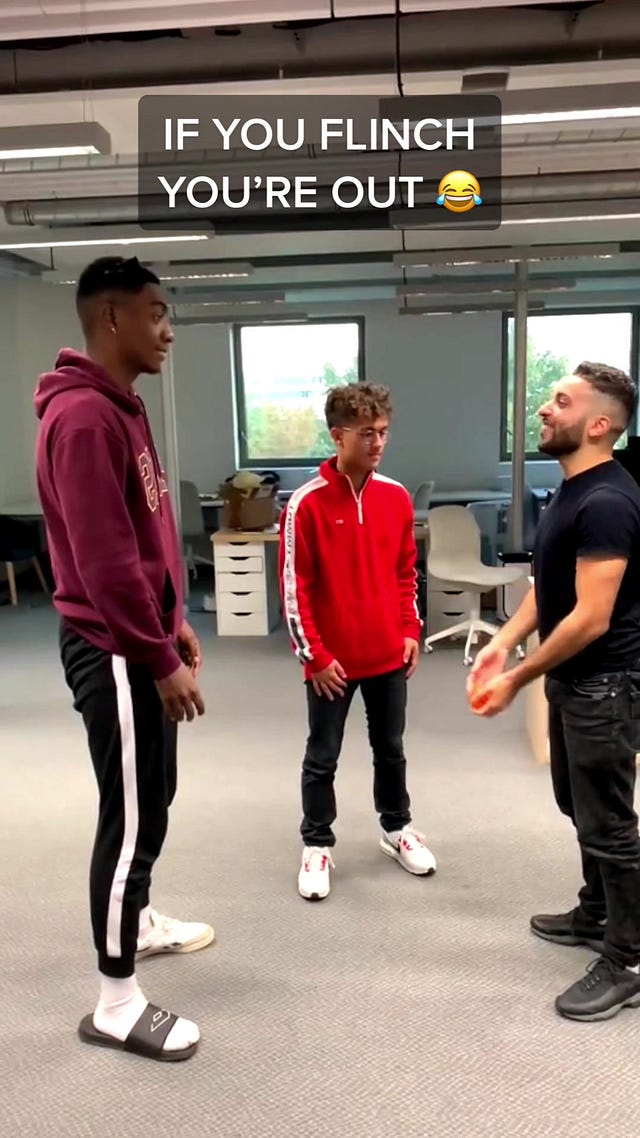
Here’s a short clip of my advisory playing a game I made up called The Monkey Game, the rules of which are highly proprietary (er, nonsensical).
As you’ll see, we sing, we dance, we throw things, and occasionally stand on chairs. The rules matter far less than the experience itself: the temporary suspension of seriousness, the shared indulgence in chaos, and the freedom to move.
Over time, I’ve built a small bench of these activities. Some are classics; others are invented on the fly. Don’t Flinch, Ninja, Poison Dart Frog, Night at the Museum, and Simon Says all work for the same reason: they are short, structured, and played with full commitment.
 Tiktok failed to load.
Enable 3rd party cookies or use another browser
Effective Brain Boosts are tightly timed—three minutes is the sweet spot—and fully bounded. Every student has a role. There are no screens, no opt-outs, and no ambiguity about when the activity begins or ends.
Just as important, they end cleanly. A Brain Boost is always followed immediately by a return to rigorous work. When used this way, these moments strengthen routines rather than undermine them—and often reveal the health of a classroom culture more clearly than academic tasks alone.
Attention is Built Together
Teaching often treats attention as something to be managed, corrected, or demanded.
Left undefined, what students do in class collapses into stillness: bodies go quiet, attention thins, and distraction predictably creeps in. But when teachers deliberately intermingle attention with movement, students are drawn into the flow of class rather than managed through it.
And when a room “crackles” with energy and joy, it’s the surest sign that the conditions for students to thrive are taking root.

https://stacks.cdc.gov/view/cdc/56637 “Physical Activity, Fitness, Cognitive Function, and Academic Achievement in Children: A Systematic Review” (2016)
https://pubmed.ncbi.nlm.nih.gov/25324805/ “Music and social bonding: “self-other” merging and neurohormonal mechanisms” (2014)
Love your video! You obviously have done a lot of evolving since the days of keeping kids in desks.
Saved to read soon!