

“It looks like spaghetti, mister!” the student teased, earning a few quiet snickers from his classmates.
And I could hardly blame them. As a minimalist at heart, the sight of a once-pristine novel scarred with notes, arrows, and sticky tabs used to make me flinch.
So it’s no surprise that when my students first see a model of my own messy attempt to wrestle with a complex text—full of scribbles, boxes, arrows, and half-formed thoughts—they can’t resist poking fun.
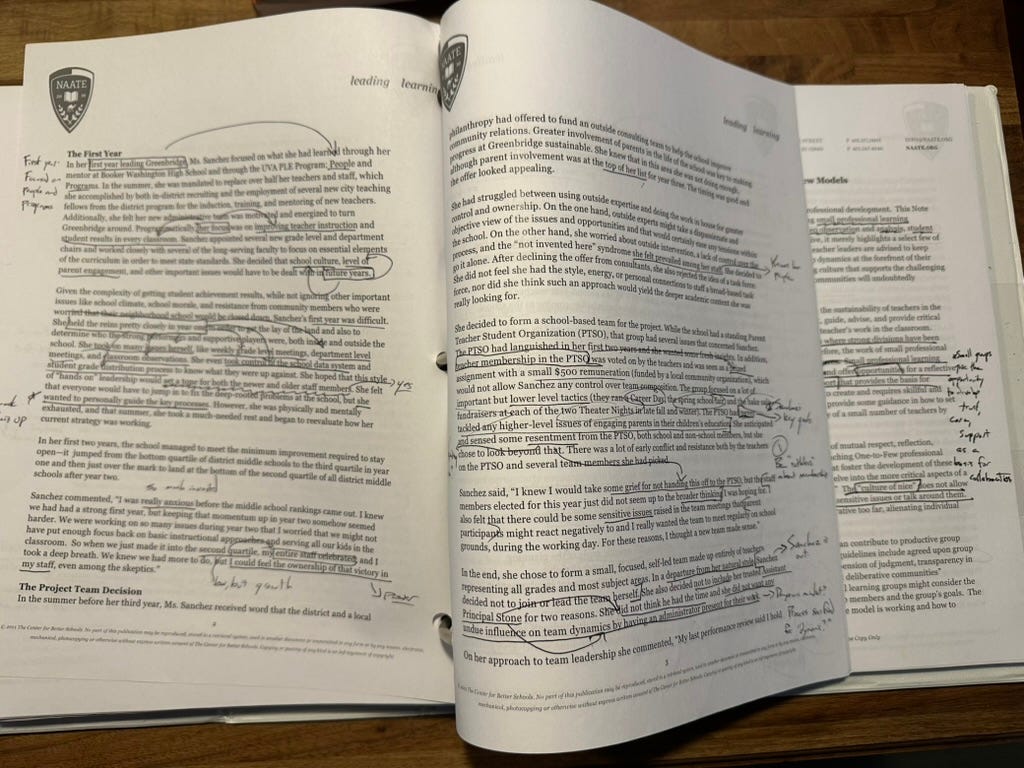
But beneath the madness, there’s a method. And done well, it’s damn effective.
The margins, it turns out, are full of opportunity. And the process of filling them up is where the real thinking begins.
“Just Reading” isn’t Enough…
“Dependent readers often fail to see reading as an active process.”
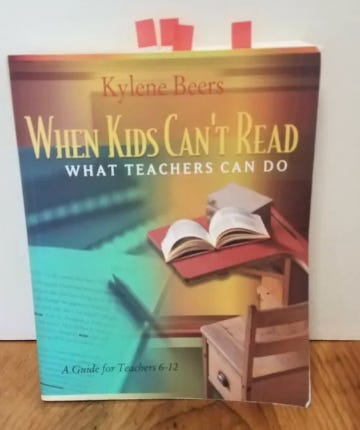
So begins the most important section of Kylene Beers’s seminal work, When Kids Can’t Read, What Teachers Can Do—"Constructing Meaning.”
It’s a familiar scene: a student hunched over a book, brow furrowed, eyes scanning the page. Then the prompt drops, and… nothing.
They’ve done what they thought was expected: moved their eyes, turned the pages, and almost certainly enjoyed the pictures.
“I read it all!” they protest. And of course it’s true — but it’s also not enough.
Meaning has to be made — a highly technical process we in the business sometimes call “thinking.”
Reading isn’t enough. Meaning has to be made — a highly technical process also known as “thinking.”

…and Hope isn’t a Strategy
Beers describes how skilled readers constantly re-read, question, and monitor their understanding — the quiet, invisible work of making meaning. As a young teacher, I spent many class periods urging students to “do these things,” believing that if I just reminded them to predict and connect, comprehension would follow.
For the next twenty minutes, read Chapter 3 and write down five text-to-self connections.
Or later:
Jonas just found out something big about the community. Write down one question you have about it.
These prompts moved the needle a little — creating reflective pauses and giving us something to talk about. But the fatal flaw was that I asked students to build meaning from their own experiences, not from the text itself.
The result was predictable: shallow insights (“I also have a baby brother who cries when he’s upset”) and heavy dependence on my strongest readers to carry the conversation. No one else produced anything worth discussing.
With no real “right answers,” my monitoring devolved into grimacing and hoping for more. Mostly, though, we wasted a lot of precious class time and thought very little.

Making Thinking Visible
It’s far more useful to tell students what to think about than to tell them simply to think. Defining a clear purpose gives students an intellectual target — and that focus sets the stage for deeper comprehension.
Ron Ritchhart, in Creating Cultures of Thinking, captures the essence of effective classrooms:
“In a culture of thinking, there is a sense of purpose to the learning.”
And indeed, the turning point came in my classroom when I learned to focus and externalize student thinking. This meant narrowing our aim, shaping our questions, and making the invisible visible. As Ritchhart later wrote in Making Thinking Visible:
“When we make thinking visible, we get not only a window into what students understand, but also how they are understanding it… making students’ thinking visible becomes an ongoing component of effective teaching.”
Purpose gives students direction; visibility gives teachers insight.
In my classroom, annotation is the tool that bridges the two. It’s the mechanism by which students put their thinking on the page — and the window through which I can see them “constructing meaning” in real time.
An Aside:
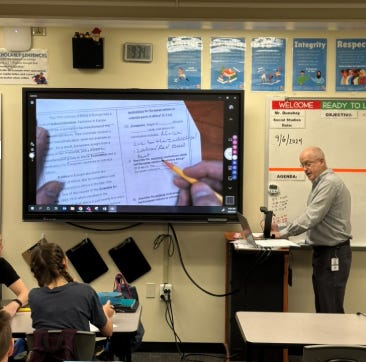
You can hack together annotations on Google Classroom with the comment tool, but it’s 100× better on paper. That’s why I’m a paper guy—and why my favorite classroom tool is still the document camera.
Doc cams are basically standard issue now, but the cheap ones on Amazon do everything you need.
A Brief Note on “Coding”
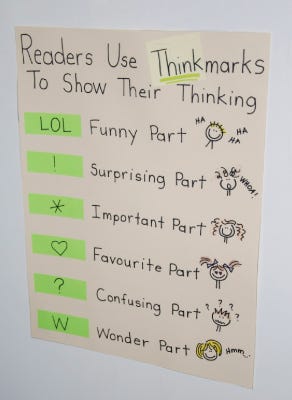
Many people associate annotation with “coding” symbols like “?” or “!” or “👓” to indicate “a question,” “I’m surprised!,” or “I have an inference!”
It’s a start, but all you end up with is a page full of reminders that you felt something, not evidence that you understood something. It’s more process than processing.
On the other end of the spectrum is the “free-range” approach: “Go mark up a few thoughts as you read.”
That might please your inner John Keating, but students quickly wander. Developing readers underline and restate; advanced readers write long, irrelevant tangents (“I also experienced darkness… when my rabbit died”).
If a text is worth analyzing, then it holds a deliberate insight — an intentional authorial move. Students won’t nail it without guidance, and that’s fine. In fact, that’s why they’re in class with you!
Instead of generic logographs or the “free-range” method, try firing up the three pillars of annotation—a set of guidelines that work especially well for middle-grade readers.
The Three Pillars of Annotation 🏛️
Here’s the model I use in my classroom when we tackle the opening paragraph of Sandra Cisneros’s classic short story “Eleven” during the first week of sixth grade.
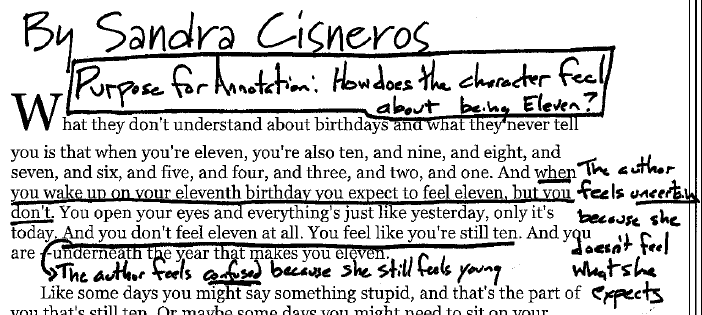
These are the simple principles that bring it to life.
1️⃣ Bread Crumbs 👣
Rule: Every time you underline or highlight, leave a margin note.
Why: Margin notes ensure underlines aren’t random. They help us track thinking and share it later in discussion or writing.
“No notes” means random highlights and lost thinking.
2️⃣ Focus 🎯
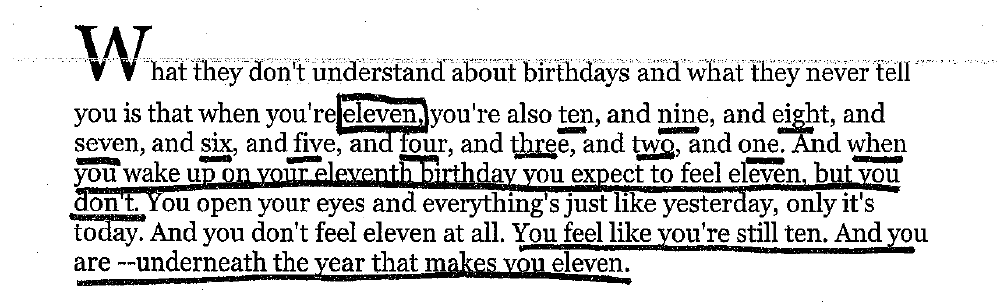
Rule: Always annotate for a purpose — and make your margin notes align with that purpose.
Why: A clear purpose anchors comprehension and grounds us in our reason for reading. It’s often tied to the day’s objective, standard, or writing prompt.
Texts can be rich — tone shifts, figurative language, character development all at once — but focus is a virtue. When a passage is dense, have students read it twice for different purposes rather than going a mile wide and an inch deep.
3️⃣ Goldilocks ⚖️
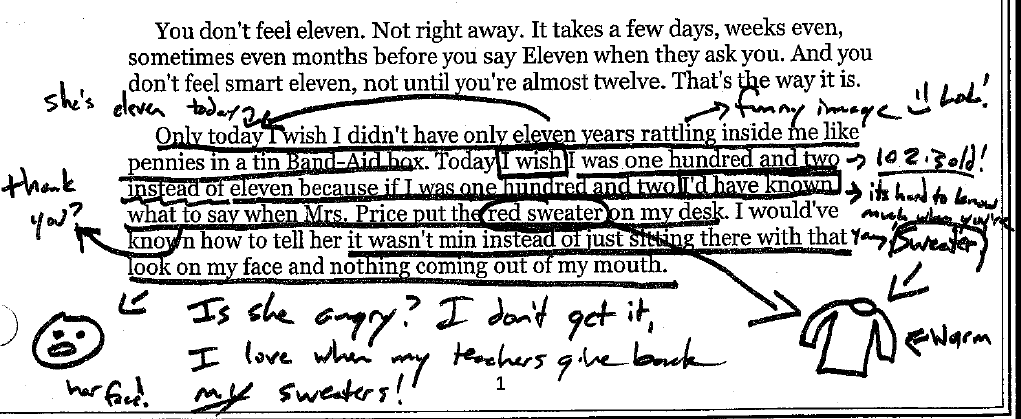
Rule: Not too many, not too few.
Why: Left alone, an 11-year-old will either do the bare minimum or fill every inch of the page. Structure helps them thrive.
I keep it simple: if there are three key things to notice, I tell students to make three marks. Don’t overcomplicate it.
What Grows from the Margins 🌱
Once you establish a routine with the pillars, annotation becomes an everyday tool. Students grow efficient and eager to wrestle with challenging text, and as complexity increases in the high school years, the young adults you’ve been training can produce some truly astonishing work.
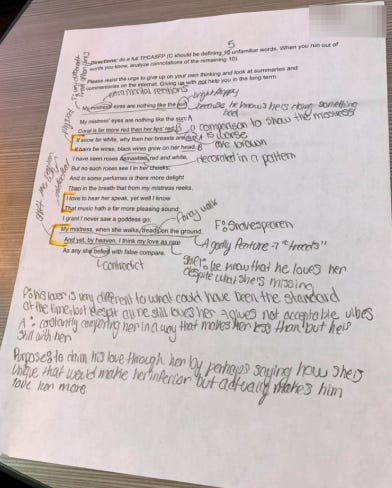
The recipe is simple: paper > laptops. Clarity and structure are your friends. Model your process more than you think you need to — then let kids loose.
Annotation is thinking made visible, and students will surprise you with the weird, creative, and brilliant ways their minds spill onto the page.
And the first time a kid beams while you show off their chicken scratch on the big screen, they’ll realize the spaghetti scribbles were beautiful all along.

This sounds great. I start my 7th grade class with 10-15 minutes of silent reading to settle the students after an already long day (mine is their last class of the day). Of course some don’t read, but at least they are quiet and can breathe (they only have a few minutes between each period).
My question is: is there a possibility that students will only read to find the clues they are asked to find? Or they could read at home, and then reread and annotate in class, and those who didn’t do the reading at home will at least do it in class?
Thank you for your insights! I am a new middle & high school teacher (but old person from the pre laptop era), and finding your substack helpful.
I love "Creating Cultures of Thinking" and I love that you're still a "paper guy." Your class sounds both purposeful and joyful!