


A lot has happened since I last published here.
First, welcome to the many new subscribers. The Middle School Literacy Project has grown to more than 700 readers, more than doubling in size since my last post. I’m grateful that so many teachers, coaches, literacy specialists, policymakers, and school leaders have found their way here.
I started this project around one central conviction: the national crisis around literacy growth in the middle grades is an eminently solvable problem.
The solutions are simple, but they aren’t always easy.
Students need less time in front of screens and more time with complex text, pencil in hand.
They need explicit instruction in comprehension and analysis. They need background knowledge and a coherent curriculum. They need daily chances to wrestle with texts that stretch them. And they need classroom routines that make serious effort and strong written work the norm.
Above all, they need prepared, engaged teachers.
So I’m excited to share that I recently sat down to discuss this very topic on the Melissa & Lori Love Literacy podcast.

Melissa and Lori host one of the most widely followed podcasts in the science of reading space, with a guest list that reads like a “who’s who” of the most important voices in the field. More importantly, their audience is full of the people I most enjoy writing for: teachers and leaders who are passionate about developing confident and capable readers.
Here’s a clip from the episode that captures the heart of the conversation:
You can listen wherever you get your podcasts, and you should subscribe to their show if you haven’t already.
Work with Me
That conversation also marks a larger moment for me: the launch of Luke Morin Literacy Consulting, where I’ll continue working with schools and districts to make middle grade literacy instruction clearer, more rigorous, and more consistent across classrooms.

The problem I’m focused on is one I saw again and again as a teacher and instructional leader: even with committed teachers, strong curriculum, and plenty of data, schools still get pulled toward fragmented skills practice, screen-based intervention, and standards-first instruction that treats reading as a checklist of isolated moves.
My work helps schools move in a different direction: toward thoughtful curriculum implementation, text-centered data cycles, consistent close reading practices, and instructional leadership that protects the real work of reading.
It is implementation work, not silver-bullet work. And I’m excited to get my hands dirty.
You can read more about my results, philosophy, and offerings at lukemorinliteracy.com.
Learn with Me
One of the hardest parts about being out of the classroom lately has been losing the chance to teach, lead, and learn alongside my peers.
So I’m also launching a free webinar series focused on intensive learning and practical skills.
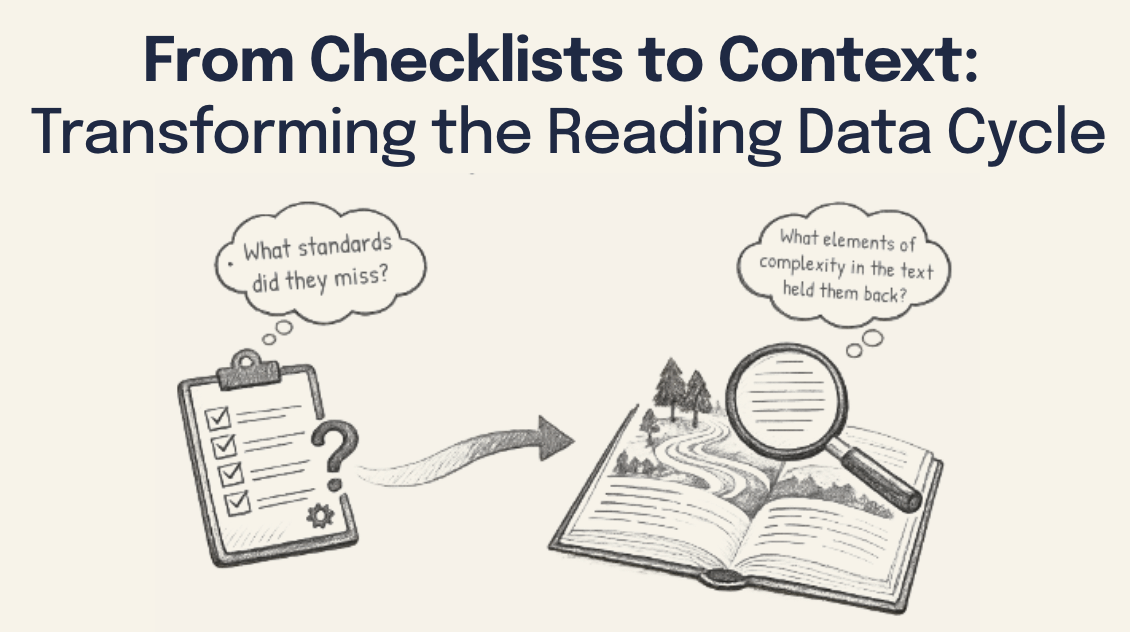
The first session grows out of a problem I wrestled with for years as a teacher and instructional leader: what if the standard students “missed” on an assessment is not actually the best place to begin?
It’s become a cliché in the last decade that reading data meetings start with the checklist:
Which standard was weak? What skill should we reteach?
But in reading, the real barrier is often hiding somewhere more specific: inside the passage itself.
That is the shift I’ll be unpacking in the first session, and it’s the foundation of a year-long coaching group I’m building for next year.
It’s a 60 minute session and in it, you’ll learn how to:
Avoid shallow standards-based reading cycles
Identify the text or task where comprehension broke down
Diagnose complexity inside the passage
Plan a curriculum-aligned instructional response
The webinar will be held on Thursday, May 28 at 8:00am MDT (10:00am EDT) and Monday, June 1 at 2:00pm MDT (4:00pm EDT), and you can sign up here:
Due to the short notice, I’ll send the recording to everyone who registers. I’d love to have you attend live, but you can still catch the session if your schedule doesn’t allow for it.
Come alone, or better yet, sign up your whole instructional team. It just might change how you think about fall development for your teachers.
Catching Up
And finally, in the event that you’re new here, here are a few essays that capture the range of my work this past year that I hope you don’t miss:

On why standards mastery is the wrong goal for reading instruction, and what students need instead.

On what rigorous reading actually requires when the text gets hard. This essay was also the foundation for my conversation with Melissa and Lori.

On annotation, student work, and making text-marking a centerpiece practice.

On why adaptive platforms cannot replace grade-level, whole-class literacy instruction.
And finally, “The Greatest Reward.” It’s short, sweet, and a bit silly; somehow, an ode to the stale gummy bear became my most-read piece by a wide margin.
A New Season
This isn’t a marketing email list, and I’ll continue to keep this space focused on the writing and ideas that brought you here: literacy, language, school improvement, curriculum, instruction, and the daily work of helping more students become stronger readers.
But this felt like the right moment to share what I’m building next.
Thank you for reading, sharing, and being part of this growing community.
Luke
—
Interested in working with me? Visit lukemorinliteracy.com to book a free 30-minute strategy call and see if we’d be a fit.
Luke, you are so talented and I cannot wait to learn more from you, as well as watch the impact of your work continue to grow!
So excited to watch this unfold. LOVE the spirit of optimism; it's infectious!